Cases study
Odour and VOC Abatement in Foundries
From emission analysis to the design of a 60,000 m³/h dry adsorption system for the abatement of benzene and aromatic hydrocarbons generated during the metal melting process.
Field of activity
Foundry
Activity
Production of grey and ductile iron castings
Location
Central Italy
Emission criticality
VOCs, aromatic hydrocarbons, benzene and odours generated during the melting process
Service supplied by Labiotest
Emission characterisation, pilot testing and a 60,000 m³/h DKFil dry adsorption system
- Emissions from melting processes
- Understanding the emission before designing the plant
- From the issue to technical data: the monitoring phase
- Why pilot testing is a strategic tool
- Condensate management
- Adsorbent media selection: where experience and data meet
- From experimental validation to the implementation of the industrial system
- Performance observed during the validation phase
- A plant designed on data, not assumptions
In the metal casting industry, the control of odorous emissions requires a targeted engineering approach tailored to the characteristics of each individual emission stream in order to identify the most appropriate abatement technology. Air streams generated during the various production stages exhibit significant physico-chemical variability: temperature, humidity, operating conditions, raw materials and process parameters directly influence the nature of the pollutants and their behaviour within the treatment system. In this context, the design of an abatement plant must be based on a thorough understanding of the emission stream.
The case study presented here originated from the need to characterise and manage an emission stream generated during the metal melting process, containing gaseous contaminants responsible for odour impact. The objective was not simply to identify a suitable treatment technology, but to develop a data-driven engineering approach based on emission characterisation, targeted monitoring and on-site pilot testing, ultimately leading to the design of a solution accurately sized to the specific characteristics of the emission.
Emissions from melting processes
A challenge often more complex than it appears
When dealing with emissions in the metallurgical sector, attention is often focused primarily on particulate matter. However, a significant share of environmental issues is associated with the gaseous fraction of the effluent. During melting, casting, cooling and handling operations, volatile organic compounds (VOCs), aromatic hydrocarbons, odorous substances and other contaminants may be generated as a result of the thermal phenomena involved in the production process.
Unlike particulate matter, these substances cannot be captured through mechanical filtration systems and require specific technologies based on adsorption, absorption or oxidation mechanisms. For this reason, before evaluating any treatment solution, it is essential to understand the actual nature of the effluent: an air stream that appears similar to another may have completely different chemical characteristics, with direct consequences on technology selection and achievable performance.
Understanding the emission before designing the plant
One of the key aspects that characterises the Labiotest approach is starting from the analysis of the problem rather than from the technology. In engineering practice, there is often a tendency to immediately identify a treatment solution without first understanding the behaviour of the emission stream. This approach can lead to oversizing, lower-than-expected performance or non-optimised operating costs.
This was the case of a company located in Central Italy, specialised in the production of grey and ductile iron castings, which involved us in managing the odour impact of a stack emission stream. During the melting and cooling phases, gaseous pollutants are generated, captured by an extraction system and conveyed to the emission point.
To avoid the critical issues associated with a design based on assumptions, we initiated a preliminary characterisation process aimed at collecting all the information required for proper plant design. The activity included the analysis of the production process, the extraction system layout and the emission management procedures, with the objective of identifying the most representative sampling point for the subsequent monitoring phase. Correct identification of the investigation point is essential: obtaining reliable data is the basis for developing effective solutions under the actual operating conditions of the plant.
From the issue to technical data: the monitoring phase
Once the investigation point had been identified, a monitoring campaign was carried out to characterise the effluent. The objective was not simply to measure a set of parameters, but to develop a comprehensive understanding of the air stream and its behaviour over time.
Fluid dynamics analysis
The first activity involved the collection of the main physical parameters of the emission stream:
- actual air flow rate;
- operating temperature;
- flow velocity;
- pressure conditions;
- any variations related to the different production phases.
These data represent the starting point for any design and sizing activity, as they directly affect contact times, pressure drops and the performance of the treatment system.
Chemical analyses
In parallel, chemical analyses were carried out to characterise the gaseous component, with the support of Gesteco. Particular attention was dedicated to organic contaminants and to the most representative process indicators, with the aim of understanding not only their concentration but also their overall contribution to the emission issue. The chemical characterisation provided essential information for the subsequent selection of adsorbent materials and for the evaluation of treatment technologies.
Olfactometric analyses
Alongside the chemical measurements, olfactometric assessments were carried out by LOD in accordance with the UNI EN 13725:2022 standard. This aspect is becoming increasingly important in industrial emission treatment projects: experience shows that the perception of emissions by the surrounding area does not always correspond to the results of chemical analyses alone. The integration of analytical and olfactometric data provides a more complete representation of the actual emission impact and allows the definition of design parameters consistent with the site-specific mitigation requirements.
Why pilot testing is a strategic tool
Once the air stream characterisation had been completed, it would have been possible to proceed directly with the design of the final treatment plant. However, when dealing with complex streams containing gaseous contaminants, theoretical modelling alone is not always sufficient to accurately predict system behaviour. Adsorption is in fact a process influenced by several factors:
- chemical nature of the contaminants;
- molecular polarity;
- stream humidity;
- operating temperature;
- contact time;
- competitive interactions between different substances.
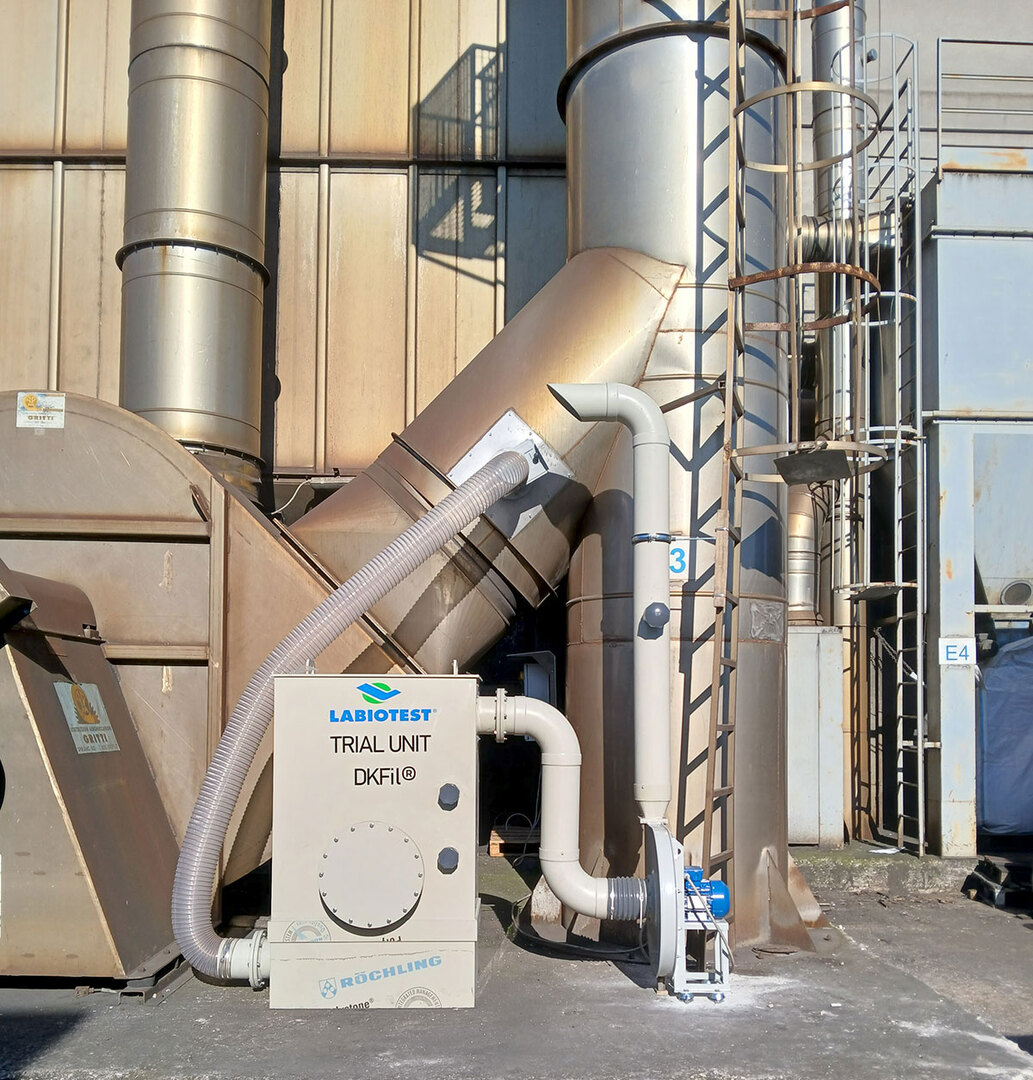
For this reason, we initiated a field pilot testing phase, with the aim of validating the technology under actual operating conditions and collecting the data required for the subsequent industrial-scale design.
Field testing
The pilot system was installed and operated for one month, allowing the treatment performance to be monitored under different production conditions. Unlike laboratory tests, field testing makes it possible to observe system behaviour in the presence of all the variables that characterise the actual process.
During the test, monitoring campaigns were carried out at the plant inlet and outlet to evaluate:
- treatment efficiency;
- performance stability over time;
- behaviour of the adsorbent media;
- influence of operating variations;
- fluid dynamic conditions of the system.
The information collected provided a valuable data set for the subsequent design phase.
Condensate management
An often critical factor
One of the aspects that emerged during the effluent characterisation was the possible presence of condensable fractions within the air stream. This is a common condition in industrial applications, but it is often underestimated during the design phase. The presence of moisture and micro-condensation phenomena can significantly affect the performance of adsorption systems by reducing the available surface area for the interaction between contaminants and the adsorbent media.
For this reason, the final design included a dedicated condensate separation section using a demister. Through coalescence mechanisms, liquid droplets are separated from the air stream before entering the adsorbent bed, helping to preserve system efficiency and extend its service life.
Adsorbent media selection: where experience and data meet
Dove esperienza e dati si incontrano
One of the less visible but most important aspects of the entire project concerns the selection of adsorbent materials. In gaseous emission treatment, there is no universal solution: each contaminant has different characteristics and interacts differently with the materials used within the mitigation system.
The media selection was carried out based on the information collected during the preliminary characterisation, analytical campaigns, olfactometric assessments and pilot testing. This approach allowed us to identify a configuration suited to the specific characteristics of the emission, optimising both treatment performance and plant operation management.
From experimental validation to the implementation of the industrial system
The monitoring and testing activities made it possible to collect all the information required for the design of the final system. The data obtained during the pilot test confirmed the suitability of dry adsorption technology for the characteristics of the monitored effluent and enabled a more accurate definition of the design parameters for the industrial plant.
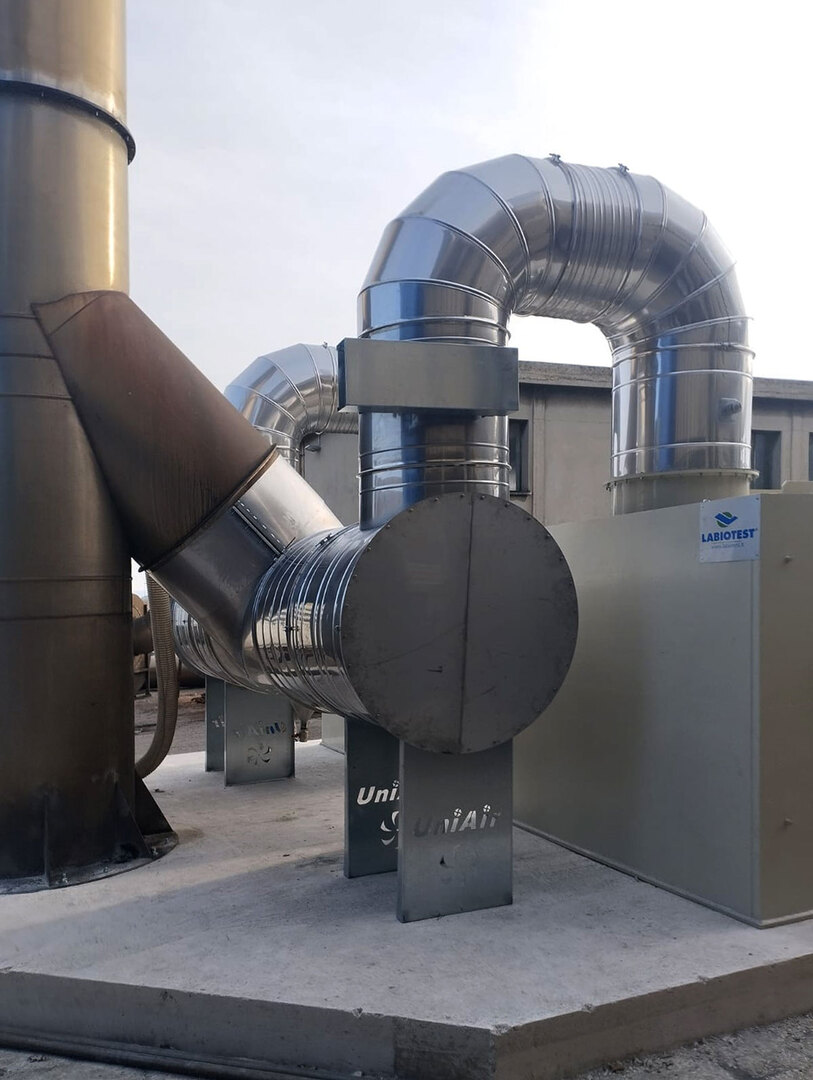
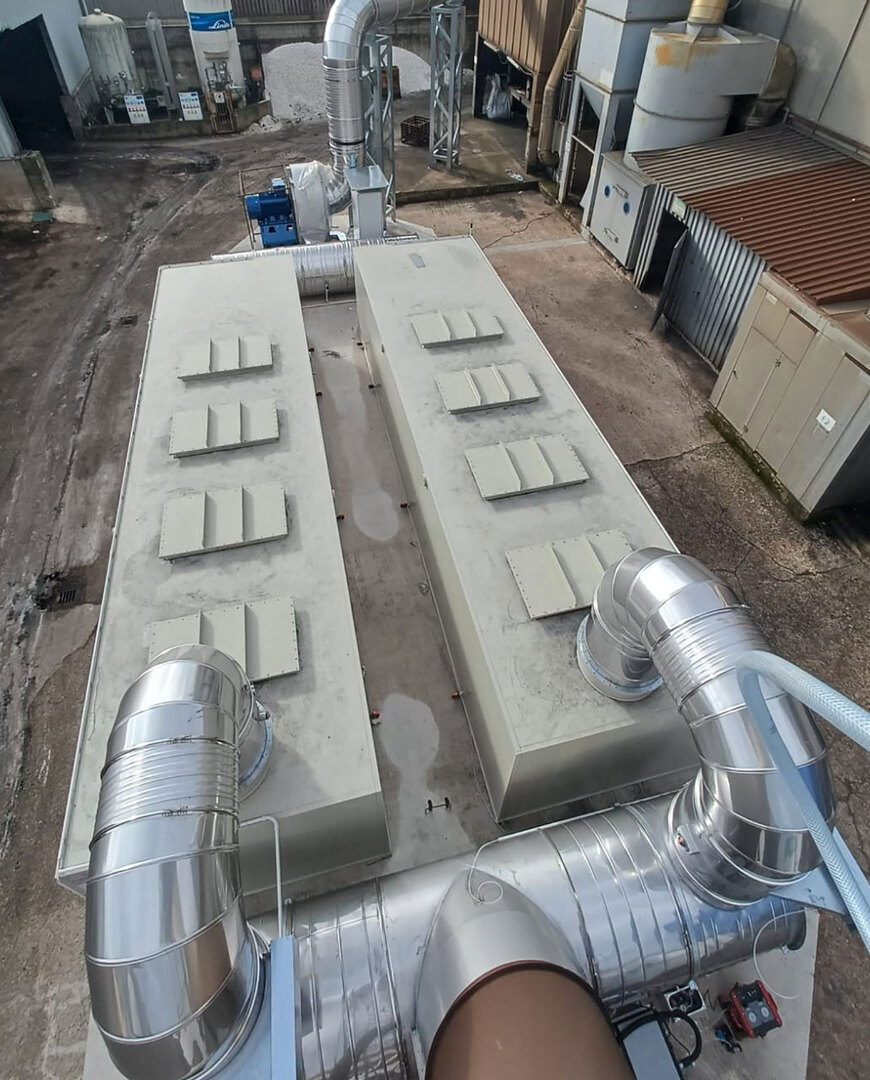
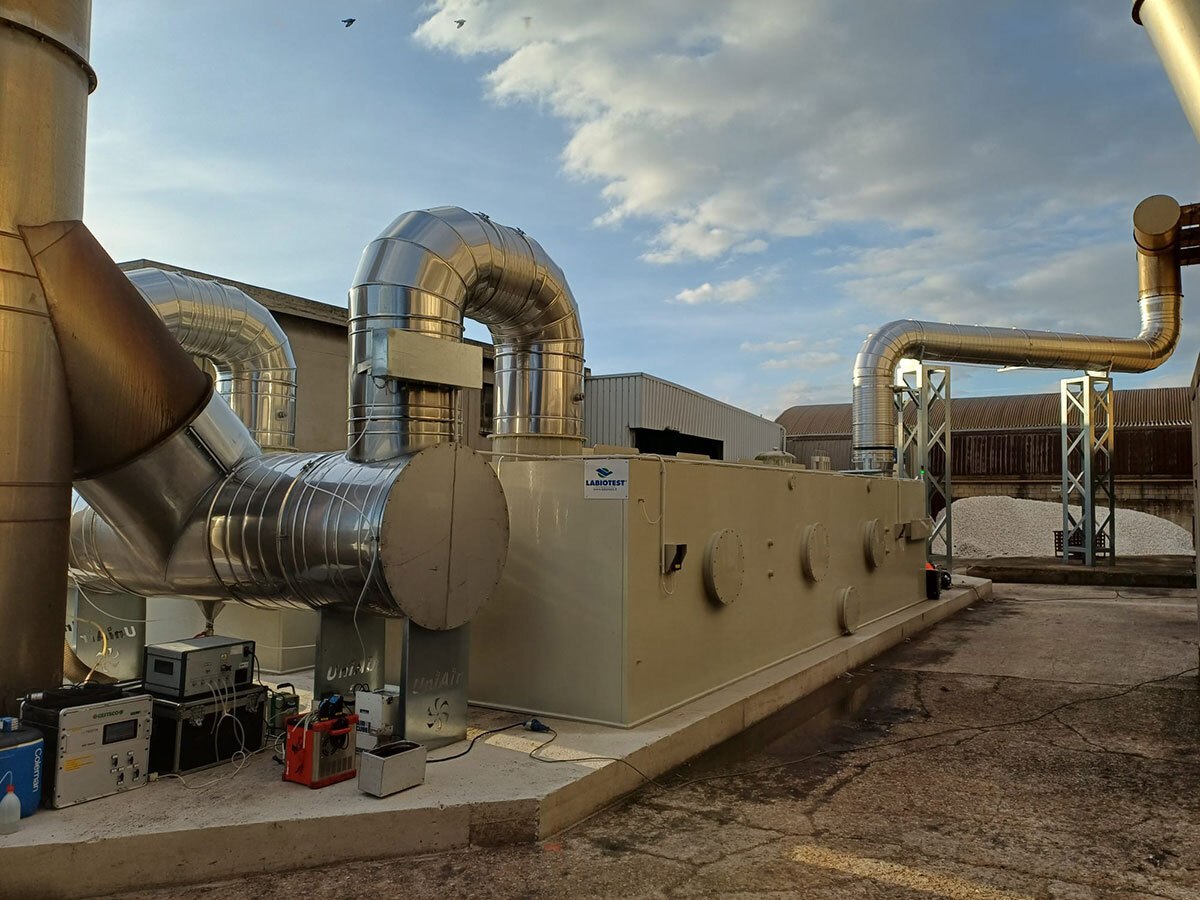
Based on the results obtained, we developed a solution consisting of two DKFil units operating in parallel, designed for a total flow rate of approximately 60,000 m³/h. The system was designed for continuous operation on emissions generated by the production process and includes:
- air stream conveying system;
- condensate separation section with integrated demister;
- DKFil dry chemical-physical treatment units;
- dedicated ventilation system;
- electrical control and automation panel;
- monitoring and operational management systems.
Performance observed during the validation phase
A key aspect of this project is that the system performance was not theoretically estimated, but validated through testing carried out directly on the actual emission stream.
The analytical campaigns performed during the testing phase showed a reduction in the concentrations of the monitored contaminants by comparing inlet and outlet values under the site's operating conditions, with particular reference to volatile organic compounds (VOCs), aromatic hydrocarbons and benzene. At the same time, olfactometric analyses showed a reduction in odour concentration measured in accordance with the UNI EN 13725:2022 standard.
The integration of chemical monitoring and olfactometric assessments made it possible to verify system performance not only from an analytical perspective, but also in terms of perceived odour impact. The plant is currently operating continuously under full-load conditions on the emissions generated by the production process.
A plant designed on data, not assumptions
Monitoring activities, analytical characterisation, olfactometric assessments and pilot testing made it possible to replace assumptions with measurable and verifiable design data. This approach enabled the selection of the most suitable adsorbent media, the optimisation of filtration section sizing, the prediction of system behaviour under actual operating conditions and the reduction of design uncertainties, with direct benefits in terms of performance reliability and plant maintenance planning.
In the foundry sector, the most suitable technology depends on the type of emission. When the issue is mainly related to odour and diffuse emissions, lighter solutions may be adopted, as described in our article Odorous emissions in foundries: problem solving. When, instead, the emission stream is conveyed and characterised by chemical contaminants such as VOCs and benzene, as in this case, a chemical abatement system designed according to real effluent data is required.
Every industrial emission has its own specific characteristics. Understanding its composition, behaviour and critical aspects is an essential step in identifying a technically suitable solution. This is why, at Labiotest, the design of a treatment plant does not start with a machine, but with a set of data: because only what is characterised and quantified can be treated effectively.
The performance described in this case study refers exclusively to the operating conditions monitored at the site where the intervention was carried out. Results depend on the specific characteristics of the emission, operating conditions and the adopted plant configuration. Any application in different contexts requires a preliminary characterisation activity and technical validation.